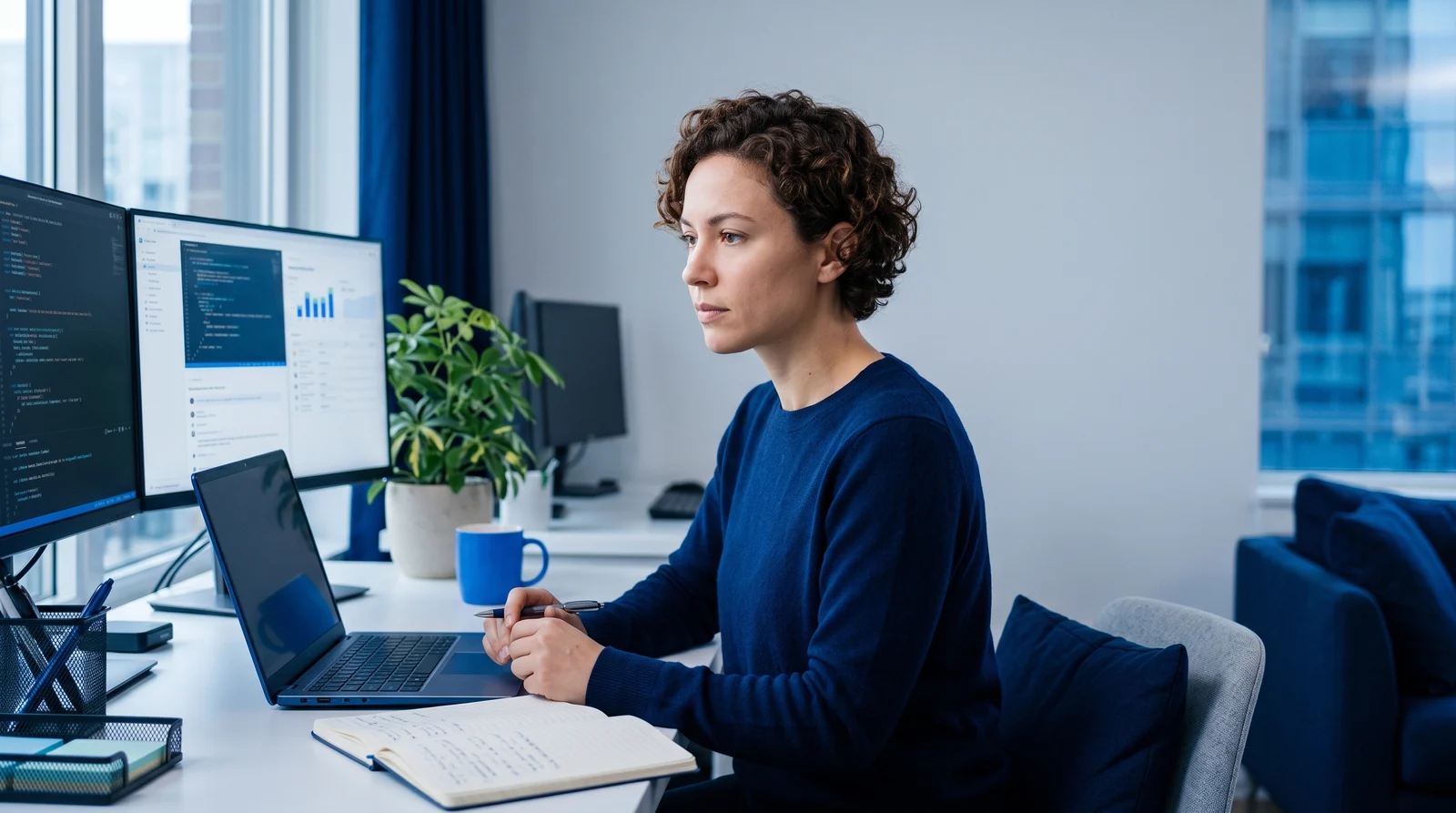
Mastering the 'Deep Work' Workspace: Optimizing Your Environment for Cognitive Peak
Mastering the 'Deep Work' Workspace: Optimizing Your Environment for Cognitive Peak
Key Points:
- Strategic environmental cues and physical boundaries prime the brain for intense focus.
- Acoustic distractions degrade productivity by up to 66%, requiring intentional sound management.
- Lighting color temperatures—specifically 6500K—significantly impact alertness and melatonin suppression.
- Physical movement yields immediate cognitive improvements equivalent to reversing cognitive aging by four years.
Research suggests that the physical and sensory design of a workspace profoundly influences cognitive performance. Achieving a state of deep work requires more than willpower; it demands intentional workspace optimization. By manipulating environmental cues, managing acoustics, utilizing digital sensory tools, and integrating physical movement, professionals can engineer their surroundings to reach a cognitive peak. This guide explores the scientifically backed strategies for designing environments that support sustained remote working performance, whether you are building a permanent home office or setting up a temporary operational base in an Airbnb halfway across the world.
The Psychology of Environmental Cues for Focus
The battle against procrastination and distraction is rarely won through sheer discipline. Environmental psychology dictates that the space where you work is often the primary factor in your output. Operating from a kitchen table or a living room sofa blurs the boundaries between relaxation and productivity, forcing your brain to expend valuable energy deciding how to act in a mixed-use space. This leads to decision fatigue before the workday has even begun.
Establishing a designated workspace leverages the psychological principle of context-dependent learning. When you dedicate a specific desk exclusively for work, you create a physical anchor. Over time, your brain recognizes this environment as a place for output, resulting in a conditioned response known as cognitive priming. The sight of your desk, the specific chair you use, and the arrangement of your tools serve as environmental cues that trigger a state of deep work. By consistently working in one defined zone and avoiding leisure activities in that same spot, you reduce your cognitive load and allow your mind to transition into focus mode seamlessly.
Managing Acoustic Environments in Shared Spaces
For remote workers operating out of coworking hubs, cafes, or shared household spaces, noise is one of the most pervasive threats to professional output. The modern open-plan design routinely reaches ambient noise levels of 60 to 70 decibels—louder than a normal conversation.
The cost of this acoustic chaos is staggering. Studies reveal that workers can lose up to 66% of their productivity when exposed to just one nearby conversation. Furthermore, human conversation triggers an automatic attention response in the brain that is nearly impossible to filter out. Research indicates that after every noise-driven interruption, it takes an average of 23 minutes and 15 seconds to fully regain deep focus.
To optimize your acoustic environment, you must take proactive measures. If you cannot control the architecture of your space, utilize active noise-canceling headphones to artificially establish a quiet zone. For dedicated home offices, aim to maintain background noise levels between 42 and 48 decibels—similar to a quiet library—which allows for concentration while preventing the isolation of absolute silence.
Lighting Temperature and Its Effect on Melatonin and Alertness
The human circadian rhythm relies heavily on environmental light cues, meaning the type of lighting in your workspace dictates your energy levels, alertness, and subsequent sleep quality. While standard home lighting is often warm and dim, reaching a cognitive peak requires a strategic approach to color temperature.
Research demonstrates that exposure to blue-enriched polychromatic light at 6500 Kelvin (K) induces nearly a 40% greater suppression of melatonin 6 compared to traditional 3000K lighting. This suppression of the sleep hormone directly correlates with enhanced subjective alertness, visual comfort, and significantly faster reaction times in tasks requiring sustained attention.
For maximum workspace optimization, utilize bright, high-intensity, short-wavelength lighting (5000K to 6500K) during your primary working hours to mimic the midday sun and sharpen cognitive execution. However, to protect your restorative sleep cycle, you must transition to warmer lighting (2700K to 3000K) at least two to three hours before bedtime, as this allows natural melatonin production to resume.
Choosing the Right 'Focus Gear' for Portable Setups
With approximately 58% of Americans now having the opportunity to work remotely at least one day a week, the demand for portable, high-performance gear has never been higher. Digital nomads and hybrid workers face the unique challenge of maintaining ergonomic integrity without the luxury of heavy, stationary office furniture.
Working directly on a laptop placed flat on a table forces a hunched posture that quickly leads to neck strain, back pain, and diminished focus. A proper portable setup must elevate the screen to eye level—ideally 12 to 18 inches away from your face. Lightweight, foldable laptop stands, such as the MOFT Z or the Roost, weigh under a pound and slip easily into a carry-on, yet they provide the structural elevation necessary for proper spine alignment.
Paired with a compact Bluetooth keyboard and an ergonomic mouse, a laptop stand recreates the desktop feel anywhere in the world. Additionally, dynamic setups that allow you to alternate between sitting and standing can boost productivity by up to 25% while mitigating the fatigue that derails long work sessions.
Designing the Perfect 'Anchor' Environment in Any Airbnb
The rise of the global remote workforce has birthed entirely new travel behaviors. Visas specifically designed for location-independent professionals, such as the Portugal D8 Visa, offer temporary stays of up to 12 months or residence permits valid for two years. As professionals relocate for longer periods, the standard of temporary accommodations has shifted. AirDNA data from 2025 reveals that 50.8% of global short-term rental listings now advertise a dedicated workspace.
However, a dining chair shoved under a small table does not constitute an anchor environment. To facilitate deep work in an Airbnb, you need a setup that mirrors a professional office. The desk surface should be 28 to 30 inches high and at least 40 inches wide to accommodate a laptop, notebook, and external monitor without feeling cramped.
When booking or arranging your temporary space, ensure the workstation is positioned near a window for natural light but away from high-traffic areas like the kitchen or living room. Most importantly, demand high-speed internet reliability. A stable connection with a minimum of 100Mbps download and 20Mbps upload speed is non-negotiable for seamless video conferencing and heavy data transfers.
Using Digital Sensory Tools Like Brown Noise and Binaural Beats
When physical environmental controls fall short, digital sensory tools can artificially induce states of high concentration. Two of the most effective auditory interventions are binaural beats and brown noise.
Binaural beats involve playing two slightly different frequencies into each ear. The brain perceives the mathematical difference between the two tones and aligns its own neural oscillations to match it—a process known as neural entrainment. Studies utilizing 40 Hz gamma-frequency binaural beats have shown significant enhancements in cognitive flexibility 15, reaction times, and working memory. Experts recommend using 40 Hz beats in short, five-minute bursts before a task to "prime" the brain for intense focus, rather than listening continuously for hours.
For continuous auditory masking, brown noise is highly effective. Featuring a lower, richer frequency profile than white noise, brown noise mimics the sound of a rushing river or heavy rainfall. It acts as an acoustic blanket, drowning out unpredictable background sounds that derail attention. Emerging research suggests that brown noise is particularly beneficial for individuals with ADHD, as it utilizes stochastic resonance to provide the optimal level of cortical arousal 17 required to maintain focus on under-stimulating tasks.
The Role of Physical Movement in Maintaining Cognitive Stamina
Workspace optimization extends beyond the furniture and the senses; it encompasses how you move your body within the environment. Sedentary behavior is a known enemy of sustained focus, but recent clinical data highlights just how vital movement is for immediate brain health.
A November 2024 study by the Penn State College of Medicine 19 found that engaging in everyday physical activity provides instant cognitive benefits. Middle-aged participants who reported being physically active within the previous 3.5 hours demonstrated improvements in cognitive processing speeds equivalent to being four years younger. These benefits were observed regardless of whether the movement was high-intensity, like jogging, or low-intensity, like completing household chores.
Furthermore, an intriguing November 2025 study published in PNAS uncovered a surprising synergy between cognition and endurance. Researchers discovered that engaging in demanding cognitive tasks while moving increases the subjective perception of effort, but paradoxically reduces the objective, actual energetic cost of the physical activity itself. Integrating brief walks, standing desk shifts, or light stretching into your remote working routine does not drain your stamina; it fundamentally recharges your cognitive processing speed and keeps your mind sharp for the next block of deep work.
Key Takeaways
- Designate a specific zone: Combat decision fatigue and trigger cognitive priming by working only in a dedicated, consistent workspace.
- Silence the disruption: Protect your remote working performance by managing noise; remember that a single conversational interruption costs over 23 minutes of focus.
- Leverage light temperatures: Use 6500K blue-enriched lighting during the day to suppress melatonin and boost alertness, shifting to 2700K warm light in the evening.
- Elevate your portable gear: Invest in lightweight laptop risers and separate peripherals to maintain an ergonomic posture that prevents fatigue.
- Vet your temporary anchors: When booking Airbnbs, insist on a 40-inch desk, an ergonomic chair, and a minimum of 100Mbps internet speed.
- Mask with sound: Utilize 40 Hz binaural beats for pre-task priming and brown noise for continuous acoustic masking to sustain concentration.
- Move to think faster: Break up your workday with light physical movement to instantly improve cognitive processing speed and maintain mental endurance.