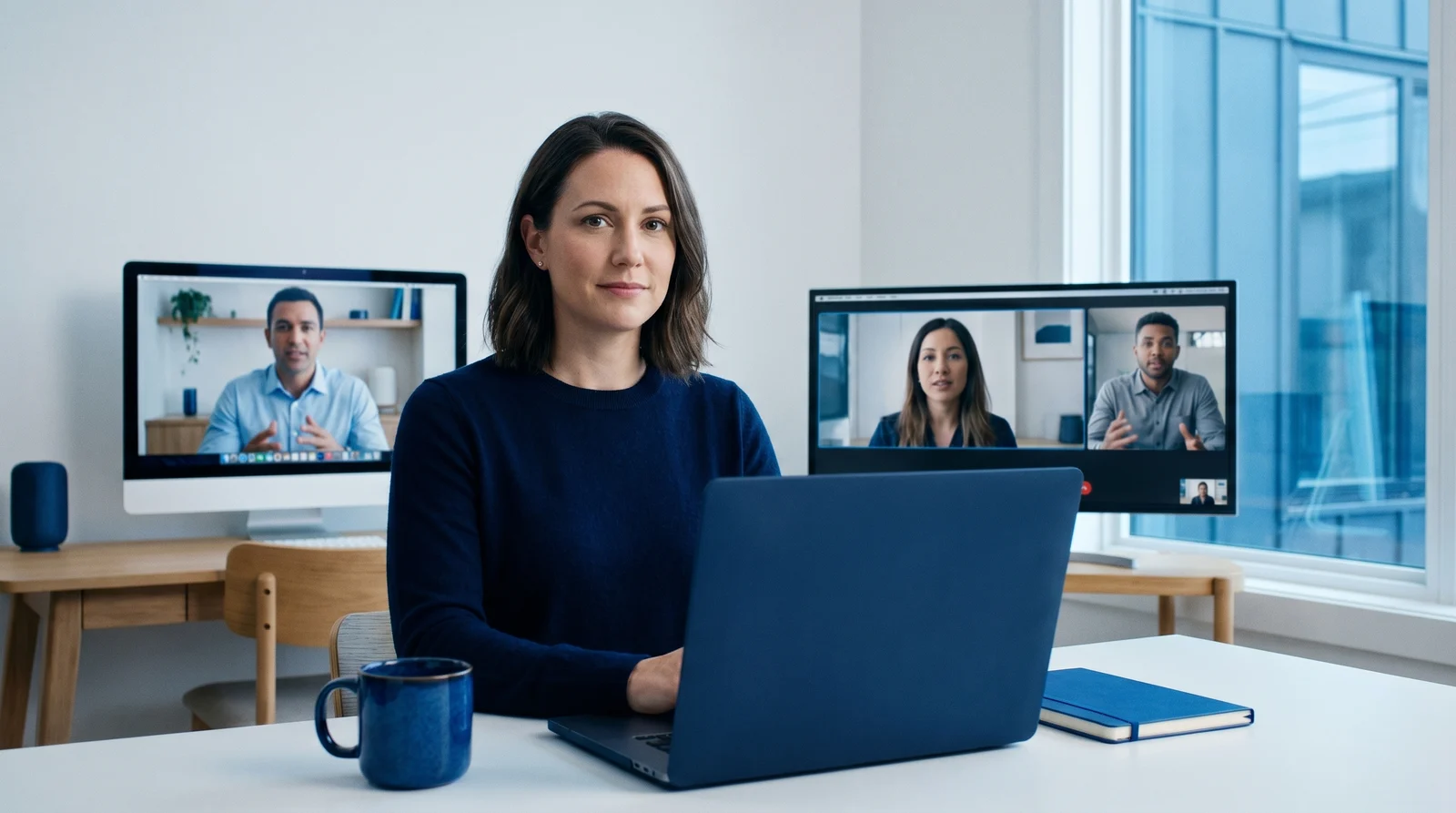
Remote Succession Planning: How to Identify and Develop Future Leaders from Afar
Remote Succession Planning: How to Identify and Develop Future Leaders from Afar
It is a common paradox in modern business: distributed teams offer access to a vast, global talent pool, yet leadership pipelines often run dry because executives cannot physically "see" their next generation of managers in action. Key points to consider: Research indicates that prioritizing internal mobility retains top talent, traditional markers of leadership do not cleanly translate to asynchronous environments, and proactive digital frameworks are essential to avoid critical skill gaps. Finding the right talent used to rely on physical proximity—the hallway chats, the late-night whiteboard sessions, and high-visibility boardroom presentations. Without those traditional touchpoints, companies are leaving their future at risk. According to the 2023 Gartner Board of Directors Talent Survey, only 51 percent of surveyed directors report their company has a written CEO succession plan, leaving the rest vulnerable to abrupt leadership vacuums. Building a resilient remote organization requires a shift from managing by presence to managing by outcomes, utilizing asynchronous tools, and deploying targeted peer-mentorship to ensure you are identifying remote leaders who can guide your company forward.
Introduction: The challenge of spotting leadership potential through a screen
In a traditional office, leadership potential is frequently, albeit flawed, correlated with physical presence. The employee who stays at their desk until 7:00 PM or speaks the loudest during a synchronous meeting is often the one tapped for promotion. In a distributed workforce, proximity bias becomes a major liability. When your team spans multiple time zones, visa statuses, and working styles, relying on visibility to dictate promotions means you will overlook your most competent, quiet operators.
The stakes for getting remote succession planning right are remarkably high. Modern workers are not tethered to local geography; a top-performing developer on an H-1B visa or a digital nomad working from Portugal can easily accept a competing offer without ever changing their physical location. If they do not see a clear future with your organization, they will log out and move on. According to a LinkedIn Workforce Learning Report, 94 percent of employees state they would stay at a company longer if it invested in their career development. Furthermore, data from Humu reveals that employees who do not see opportunities for development and growth are nearly eight times more likely to consider leaving their organizations. To retain top talent, organizations must implement structured, deliberate talent pipelines that do not rely on physical proximity.
Redefining leadership traits for a remote-first work environment
When identifying remote leaders, you must discard the outdated criteria of physical charisma and office politics. Leading from afar requires a fundamentally different set of core competencies.
First, remote leaders must be masters of "extreme goal clarity". In an asynchronous setting, ambiguity is the enemy of productivity. If a manager assigns a vague task, an employee across the globe might waste three days guessing the parameters before their time zones align for clarification. Future leaders in your organization should be those who default to clear, written communication and always define the exact parameters of success—often referred to as the "Definition of Done".
Second, successful remote leaders possess high emotional intelligence and active listening skills. Without body language to rely on, managers must be highly attuned to digital burnout, isolation, and workload imbalances. According to eLearning Industry, leaders must consciously practice active listening and concise communication to keep remote teams engaged.
Finally, adaptability and trust are paramount. The best candidates for remote succession planning are those who do not micromanage the clock, but rather trust their peers to manage their own schedules while delivering high-quality outcomes.
Creating transparent pathways for internal mobility and promotion
Remote employee growth stagnates when career ladders are invisible. In an office, junior employees can physically observe the hierarchy and understand the steps required to move from an associate to a director. Remotely, career pathways must be explicitly documented and communicated.
Organizations must implement competency modeling, which translates strategic priorities into the specific capabilities required for each role. This framework provides a transparent, measurable basis for talent investment. By mapping out exactly what skills, certifications, and project experiences are required to advance, you remove the guesswork from internal mobility.
Effective succession planning requires identifying one or two potential candidates for critical roles and conducting a formal gap analysis. Share this data with the candidates. When high-performing employees understand exactly where their skill gaps lie and see that the company has a documented plan to help them cross that bridge, their engagement and loyalty increase dramatically.
Designing remote stretch assignments to test leadership readiness
Formal workshops and video training modules are insufficient for remote leadership development. To truly test and develop a candidate's readiness for the next level, you must rely on experiential learning.
Applying the 70-20-10 Learning Model
The most effective leadership development programs utilize the 70-20-10 model: 70 percent stretch assignments and action learning, 20 percent coaching and mentoring, and 10 percent formal training. Stretch assignments place high-potential employees in situations that push them slightly beyond their current capabilities, forcing them to adapt and lead.
In a distributed environment, a stretch assignment might look like:
- Asking a mid-level manager to lead an asynchronous sprint with a cross-functional team spanning three different continents.
- Assigning a high-potential employee to audit and redesign the digital onboarding flow for new hires.
- Requiring candidates to lead a high-stakes virtual brainstorming session where they must actively facilitate conversation and synthesize ideas across digital whiteboards (e.g., Miro or Notion).
These projects should be sponsored by senior leaders and tied directly to real organizational challenges. The return on investment for this experiential approach is substantial. DDI's 2023 Global Leadership Forecast demonstrates that organizations with strong, structured leadership development practices experience 2.4 times higher revenue growth than their competitors.
Peer-to-peer mentoring: Building leadership skills outside the hierarchy
Managing remote teams effectively means acknowledging the emotional and psychological toll of distributed work. According to Buffer's State of Remote Work survey, remote workers consistently cite loneliness and isolation as their most significant challenges. One of the most effective ways to combat this isolation while simultaneously grooming future leaders is through peer-to-peer mentoring.
Also known as lateral mentoring, this practice pairs employees at similar organizational levels to share skills, knowledge, and support. Because peer mentors lack the formal authority of a direct supervisor, these relationships create a "safe haven" where employees feel comfortable asking vulnerable questions, role-playing difficult conversations, and admitting knowledge gaps.
For succession planning, peer mentoring programs are a goldmine. They give junior employees a platform to showcase their leadership capabilities outside of their immediate department. Employees who may not have been recognized for their leadership potential by their direct managers often gain crucial visibility through cross-functional mentoring circles. By distributing the emotional load of leadership across micro-networks, you build a more resilient and deeply connected organization.
Documenting performance and tracking growth asynchronously
You cannot successfully manage a remote talent pipeline using legacy, synchronous performance management tools. A remote environment requires a rigid operational framework where high flexibility for the employee is matched by high discipline from the organization.
Establishing the Overlap Window
Transitioning to asynchronous performance tracking means moving away from the "always-on" culture. Instead, identify a two-to-three hour "Overlap Window" where the maximum number of your global time zones naturally intersect (for example, 9:00 AM to 11:00 AM EST, which generally accommodates US, European, and Indian teams). Reserve this highly valuable synchronous time strictly for sensitive 1-on-1 performance conversations, strategic debates, and complex problem-solving. Protect the rest of the day for deep, uninterrupted, asynchronous work.
During asynchronous hours, rely on digital documentation to track progress. Modern performance management software allows HR teams to track outcomes rather than hours logged at a keyboard. Replace the traditional daily Zoom stand-up with a written Monday commitment where employees document their primary outcomes for the week, how those connect to quarterly objectives, and what blockers they foresee.
By forcing performance documentation into written, objective formats, you strip away the subjective noise and proximity bias of the physical office. Managers can assess leadership candidates based on the actual deliverables they ship, the clarity of their asynchronous communication, and their documented ability to clear blockers for their peers.
Conclusion: Future-proofing your distributed organization
Remote succession planning is not a one-time administrative chore; it is an agile, ongoing business imperative. The cost of waiting for a crisis to build your leadership pipeline is simply too high. With executive turnover increasing—Challenger, Gray and Christmas reported a 41 percent increase in CEO departures in late 2023—and nearly two-thirds of family businesses lacking a documented transition plan, organizations that fail to prepare will find themselves scrambling to replace critical institutional knowledge.
Do not wait for a key leader to hand in their notice before you start looking for their replacement. By redefining what leadership looks like in a digital space, creating transparent pathways for mobility, utilizing stretch assignments, and tracking performance asynchronously, you can identify and develop a robust bench of future leaders—no matter where in the world they log in from.
Key Takeaways
- Shift from presence to outcomes: Proximity bias kills remote talent pipelines. Evaluate future leaders based on their documented output, not their physical visibility or time logged.
- Prioritize extreme goal clarity: Remote leaders must excel at written communication, active listening, and defining the precise parameters of success to avoid asynchronous lag.
- Map transparent career pathways: Retain top talent by utilizing competency models and conducting gap analyses so employees know exactly what is required to advance.
- Deploy experiential stretch assignments: Use the 70-20-10 model to test leadership readiness by putting high-potential candidates in charge of real, cross-functional projects.
- Leverage peer-to-peer mentoring: Combat remote isolation and uncover hidden leadership potential by connecting employees across lateral, cross-departmental networks.
- Implement an "Overlap Window": Consolidate synchronous performance conversations into a brief, globally overlapping timeframe, leaving the rest of the day for deep work and objective, asynchronous progress tracking.
Sources:
- nacdonline.org
- industrypro.com
- remotenomadjobs.com
- bebee.com
- developus.com
- porchlightbooks.com
- performspark.ai
- elearningindustry.com
- researchgate.net
- leadingpractice.com
- aidarsolutions.com
- edsi.com
- hyring.com
- hubstaff.com
- chronus.com
- bigthink.com
- skedda.com
- mentorloop.com
- salarybox.in
- successionhr.com
- shrm.org