The Auditory Office: Engineering Your Soundscape for Maximum Remote Focus
The Auditory Office: Engineering Your Soundscape for Maximum Remote Focus
Key points: Environmental noise significantly elevates physiological stress and cognitive load; masking strategies like color noises and binaural beats effectively stabilize attention; and architectural acoustic treatments yield measurable productivity gains. Research suggests that while the visual aesthetics of a home workspace receive extensive attention, the acoustic environment is equally critical to professional output. The shift to remote work eliminated the traditional office hum but introduced unpredictable household disruptions, leaving many professionals struggling to maintain their concentration. Engineering your remote work soundscape is not simply about eliminating sound; it is about strategically deploying frequencies, continuous acoustic backgrounds, and localized architectural treatments to reduce mental fatigue. By systematically managing auditory stimuli, remote workers can minimize distractions and reliably trigger deep flow states.
The Science of Sound and Focus
The relationship between background noise and cognitive performance is a heavily researched domain in cognitive psychology, primarily observed through the "irrelevant sound effect." When working professionals are exposed to background speech or unpredictable household noises, their working memory and selective attention suffer. An April 2024 study demonstrated that exposure to task-irrelevant speech at just 50 decibels significantly impairs accuracy in serial recall tasks while concurrently triggering a physiological stress response. Participants exposed to these auditory distractions exhibited faster heart rates and lowered Heart Rate Variability (HRV), a primary physiological marker of stress.
Counterintuitively, a November 2024 publication in the Journal of the Acoustical Society of America found that task-irrelevant whispered speech can be more distracting than normal speech. Softer, intelligible sounds command additional listening effort, which unintentionally hijacks the brain's attentional resources and diverts them away from the focal task. For remote workers, this means the muted sounds of family members talking in the next room can be highly detrimental to focus. A 2023 Canadian sociological survey highlighted that 25% of remote workers experience a quantifiable negative impact on their daily performance due to residential noise conditions. Conversely, when employees can actively control their environments and manage these distractions, remote setups can yield a 15% to 25% increase in total productivity.
Decoding Color Noises
Not all noise is detrimental. Continuous, static-like frequencies can create a masking effect that effectively raises the brain's auditory threshold, preventing sudden environmental sounds from shattering a worker's concentration. These functional sounds are categorized by "colors" based on their frequency spectrums.
| Noise Color | Frequency Profile | Auditory Characteristic | Primary Remote Work Application |
|---|---|---|---|
| White Noise | Equal energy across all audible frequencies | Television static, whirring fan | Masking sudden, unpredictable household sounds; particularly beneficial for ADHD. |
| Pink Noise | Higher energy in lower frequencies | Steady rainfall, rustling leaves | Sustaining psychomotor speed, promoting deep relaxation, and reducing mental fatigue. |
| Brown Noise | Concentrated heavily in very low frequencies | Deep waterfall, distant thunder | Eliminating high-pitched hiss to anchor focus and soothe continuous mental wandering. |
While white noise is the clinical standard for masking, its high-frequency hiss can cause ear fatigue over an eight-hour workday. Consequently, leveraging brown noise for focus has emerged as a superior strategy for extended deep work sessions. Because brown noise mimics deep, natural rumbles, it successfully isolates the worker from external stimuli without introducing auditory strain.
Binaural Beats and Brainwaves
For professionals seeking to hack their neurophysiology, binaural beats offer a more targeted approach than standard color noises. A binaural beat is an auditory illusion created when two tones with slightly different frequencies are played simultaneously into each ear. The superior olivary complex in the brain stem processes these two tones and perceives a third, distinct beat equal to the mathematical difference between them.
The underlying principle can be expressed as: [ f_{\text{beat}} = |f_{\text{right}} - f_{\text{left}}| ]
Through a process called neural entrainment, the brain's electrical activity begins to synchronize with this perceived beat frequency. A February 2025 controlled study conducted at the University of Texas at Austin confirmed that exposing participants to 40 Hz (gamma frequency) binaural beats combined with white noise successfully entrained brain activity and enhanced general attention performance.
By selecting specific frequencies, workers can leverage binaural beats productivity protocols to match their desired cognitive state. Alpha frequencies (8–14 Hz) are ideal for lowering stress and entering a relaxed flow state for creative writing, while Beta frequencies (14–30 Hz) are optimal for high-energy analytical thinking and complex problem-solving.
The Lo-Fi Phenomenon
If clinical color noises and binaural frequencies feel too sterile, lo-fi (low-fidelity) music serves as a highly effective middle ground. Lo-fi hip-hop is characterized by mellow tempos, loop-based rhythms, and a distinct lack of vocals. This specific combination of traits makes it the ultimate auditory environment deep work backdrop.
The absence of lyrics is the most critical component of lo-fi's success. A landmark 2011 study published in Applied Cognitive Psychology demonstrated that music containing lyrics severely disrupts verbal memory tasks, such as reading comprehension and drafting emails, because the brain's language processing centers become overloaded.
Furthermore, a March 2026 study evaluating study music found that lo-fi prevents distraction primarily through its predictability. Because the tracks lack sudden dynamic shifts in volume or tempo, the brain requires almost zero cognitive capacity to process the music. With tempos generally hovering around 60 to 80 beats per minute, lo-fi aligns closely with the human resting heart rate, effectively reducing study stress and minimizing hyperactivity.
Managing Disruptive Environments
When software and playlists are insufficient to block out a chaotic household, hardware and architectural interventions become necessary.
Active Noise Cancellation (ANC) Technology
Active noise-canceling headphones utilize external microphones to detect incoming ambient noise and instantly generate inverse soundwaves to neutralize the disruption. According to a November 2023 report featuring Dr. Sapna Sriram, a clinical injury expert, continuous exposure to distracting household noises leads to chronic stress and auditory fatigue. ANC headphones directly counteract this, creating a peaceful localized environment that preserves mental well-being. The demand for this technology in remote work is so profound that market analysts project the global ANC headphone market will reach $23.6 billion by 2035.
Acoustic Treatment for Home Offices
Headphones address the symptoms of a poor acoustic environment, but physical acoustic treatments address the root cause. Standard home offices feature hard drywall, glass, and hardwood floors that reflect up to 95% of sound energy, creating an echo chamber that disrupts virtual meetings and cognitive focus.
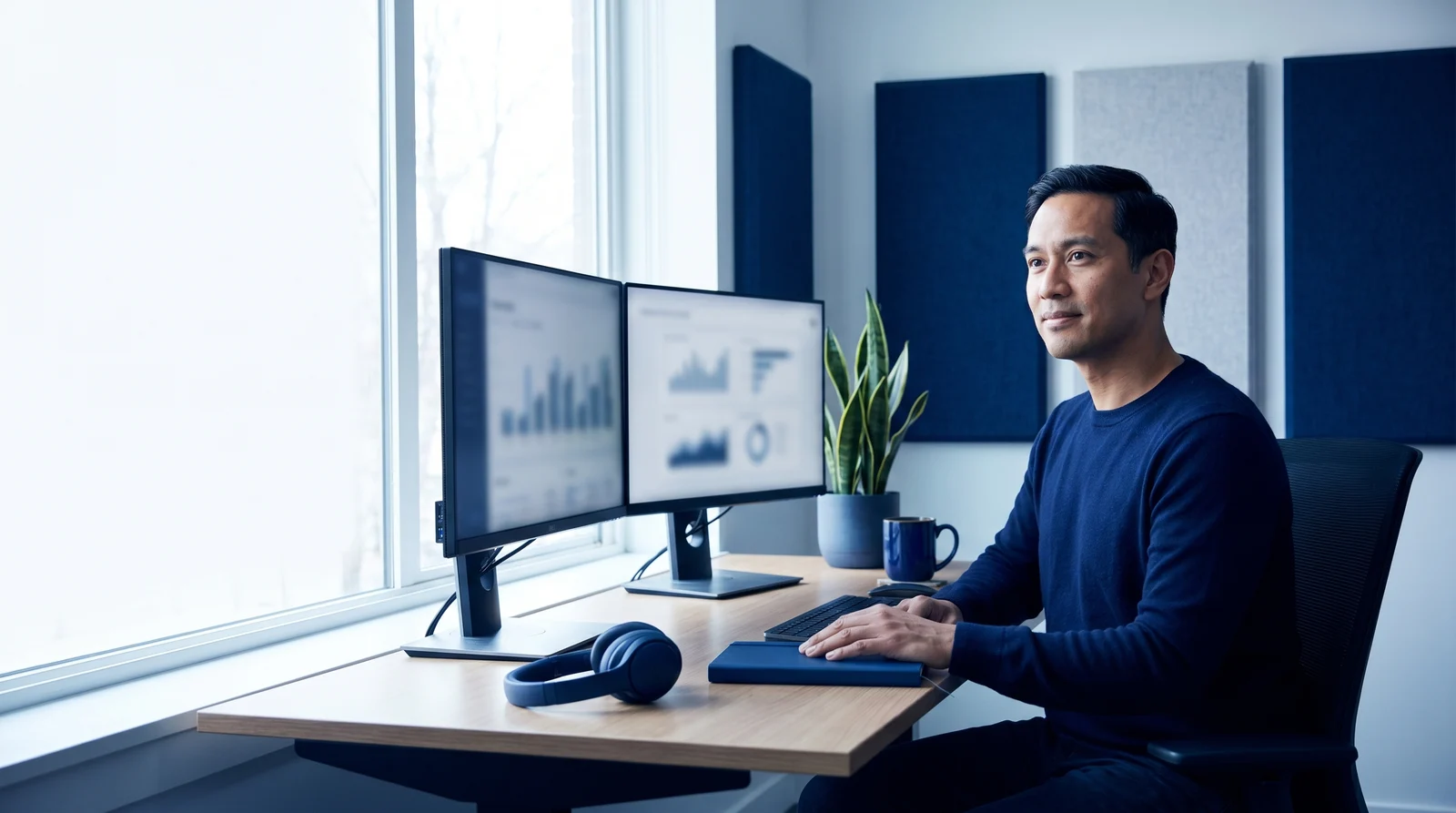
To engineer a professional soundscape, remote workers should cover 10% to 20% of their wall surface area with dedicated acoustic panels. Treatment should prioritize "first reflection points"—the areas on the wall where sound from your desk bounces directly back to your ears. Panels should be 2 to 4 inches thick and possess a Noise Reduction Coefficient (NRC) rating of 0.85 or higher to effectively capture human vocal frequencies. Avoid thin, decorative acoustic foam, which only absorbs high-end flutter and fails to manage the low-mid frequencies that cause severe room reverberation.
Building Task-Specific Playlists
Human cognition is highly susceptible to classical conditioning. By pairing specific auditory cues with specific work tasks, you can train your brain to transition into the appropriate mental state much faster. Curating music for remote work based on the specific cognitive demands of your daily schedule provides a structural anchor to an otherwise fluid remote workday.
- Routine and Repetitive Tasks: For inbox zero, data entry, or administrative cleanup, high-energy electronic dance music (EDM) or upbeat pop can elevate dopamine levels and accelerate working pace.
- Deep Focus and Analysis: For coding, financial modeling, or drafting reports, default to lo-fi beats, classical music, or instrumental jazz to prevent cognitive overload.
- Creative Ideation: Ambient electronic tracks and nature sounds (such as rainfall or ocean waves) provide a soothing backdrop that encourages expansive, non-linear thinking without demanding active attention.
Crucially, a 2017 study in Applied Cognitive Psychology confirmed that the effectiveness of any playlist relies heavily on personal preference. If the listener intrinsically enjoys the music, the positive cognitive effects and subsequent productivity gains are significantly magnified.
Silence as a Strategy
Despite the proven benefits of masking noises and functional music, there are moments when absolute quiet remains the ultimate productivity tool. The phenomenon of stochastic resonance dictates that while a moderate level of background noise can gently stimulate the neural system and aid focus, pushing past that threshold results in severe distraction.
When tackling highly complex problems, learning entirely new concepts, or engaging in dense reading comprehension, the brain's cognitive load is pushed to its absolute limit. In these instances, any auditory input—even a steady pink noise—can consume the residual processing power required to master the task. In a 2015 study assessing office noise conditions, 21 out of 30 participants explicitly stated they preferred working in total silence over any background sound when given the choice. Knowing when to pause the playlist, remove the headphones, and operate in complete silence is an essential component of mastering your auditory environment.
Key Takeaways
- Minimize speech exposure: Intelligible background speech, particularly whispered or soft speech, severely disrupts verbal short-term memory and increases physiological stress markers like heart rate.
- Leverage low frequencies: Swap harsh white noise for brown noise to mask unpredictable household distractions without causing auditory fatigue during long work sessions.
- Entrain your brainwaves: Utilize 40 Hz gamma binaural beats or 14-30 Hz beta beats to artificially induce states of deep focus and heightened analytical thinking.
- Eliminate lyrics for deep work: Instrumental and lo-fi tracks prevent the language-processing centers of your brain from becoming overloaded, preserving cognitive capacity for your actual work.
- Treat the room structurally: Apply 2-to-4-inch acoustic panels with high NRC ratings at first reflection points to eliminate reverberation, drastically improving both your concentration and your virtual meeting audio quality.
Sources:
- nih.gov
- researchgate.net
- aip.org
- nih.gov
- hrgrapevine.com
- youtube.com
- medium.com
- onlymyhealth.com
- sleepstackapp.com
- medium.com
- webmd.com
- nih.gov
- binauralbeatsfreak.com
- psychologytoday.com
- medium.com
- hibiscuscounselling.com
- brain.fm
- culturaldaily.com
- vdocomms.com
- forbes.com
- todayinstocks.com
- factmr.com
- cnacousticpanels.com
- reddit.com
- eurekaergonomic.com
- sonio.co.uk
- emerald.com
- ucpress.edu