Virtual Body Doubling: How Co-Working Streams Boost Remote Productivity
Virtual Body Doubling: How Co-Working Streams Boost Remote Productivity
As of 2025, over 32.6 million Americans—representing roughly 22% of the workforce—work remotely. While remote work productivity statistics consistently indicate that 70% of remote workers find it easier to do focused, deep work at home, many individuals still battle chronic procrastination, isolation, and task paralysis. Research suggests that the autonomy of home offices can inadvertently increase cognitive load, but a behavioral strategy is emerging as a reliable solution. By logging into structured video calls to work silently alongside strangers or colleagues, professionals are replicating the social pressure of an office environment. This practice, grounded in established psychological principles, appears highly effective for sustaining attention, offering a practical and scalable way to manage the complexities of modern remote work.
Defining Virtual Body Doubling and Its Psychological Benefits
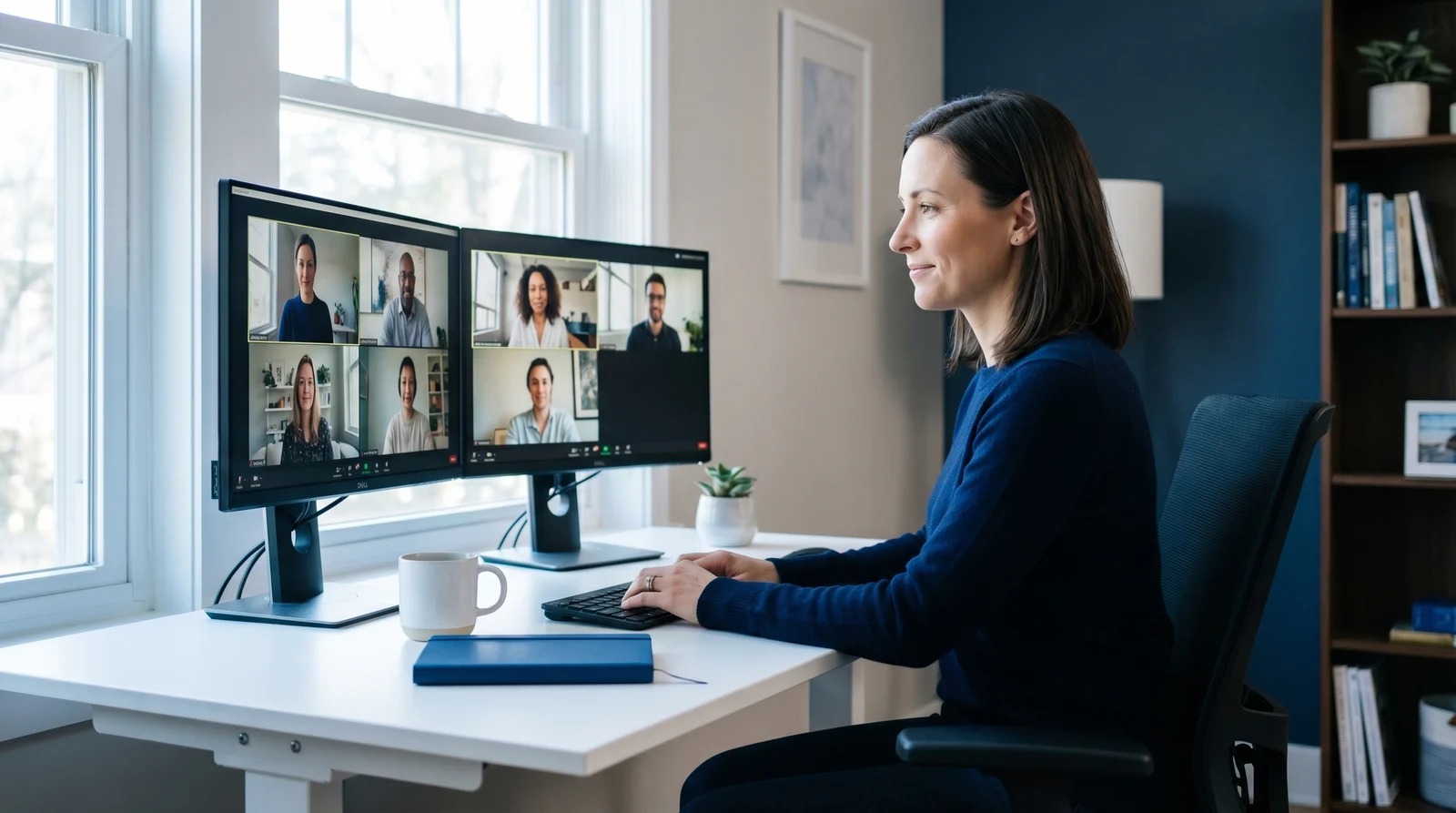
The concept of body doubling was originally coined in 1996 by ADHD coach Linda Anderson, who observed that her clients found it significantly easier to initiate and complete mundane tasks when another person was simply present in the room. Over the past few years, this practice has transitioned into the digital realm. Virtual body doubling involves joining a video call with one or more individuals, sharing your goals for the session, and working silently on your respective tasks.
While the concept sounds remarkably simple, it is supported by a robust framework of psychological and neurological mechanisms:
- The Social Facilitation Effect: First documented by psychologist Norman Triplett in 1898, this principle dictates that the mere presence of others enhances human performance on tasks. A meta-analysis of 241 studies demonstrated that social presence improves performance by an average of 16.5%.
- Mirror Neurons and Emotional Contagion: The human brain contains mirror neurons that activate both when performing an action and when observing someone else perform it. This creates a "chameleon effect." When you are surrounded by focused individuals on a screen, your brain unconsciously adopts their productive disposition. Research from Stanford University's Virtual Human Interaction Lab found that observing others working increased participants' own task persistence by 48%.
- Dopamine Regulation: Positive social interactions activate the brain's dopamine reward circuitry. Because dopamine plays a major role in motivation and task initiation, the low-pressure social interaction of a body doubling session provides a gentle neurochemical boost that helps the brain shift into action.
- Cortisol Reduction: The calming presence of others engaged in similar activities has been shown to reduce performance anxiety. A study in Behavioral Neuroscience found that social presence during challenging tasks lowered cortisol (stress hormone) levels by 23%.
The Rise of Digital Co-Working Platforms and Video Communities
As the demand for external structure has grown, a thriving ecosystem of digital co-working platforms has emerged to facilitate these sessions at scale. These applications connect users globally, ensuring that a productive environment is available at any time of day.
Focusmate, one of the earliest and most popular platforms, operates on a 1:1 model. Users from over 150 countries book 25, 50, or 75-minute sessions, at which point an algorithm pairs them with an accountability partner. After a brief greeting to state intentions, both users work in silence with their cameras on. Focusmate has facilitated over 5 million sessions and offers a free tier of three sessions per week, with an unlimited premium plan available for roughly $10 per month.
For those who prefer a group dynamic, Flow Club offers host-led group sessions. Hosting over 1,700 sessions weekly, Flow Club ensures users can find a co-working group within minutes. The platform integrates goal-tracking tools and curated background music, creating an immersive digital workspace. Priced at $40 per month, it targets professionals willing to invest in high-volume, structured focus.
Another premium option, Caveday, takes a highly guided approach. For $39.99 per month, users gain access to facilitator-led "Caves" lasting between one and three hours. These sessions mandate monotasking, enforce strict break schedules, and actively discourage participants from using their phones, making it ideal for deep work.
How Silent Accountability Partners Reduce Work-From-Home Procrastination
The core value of an accountability partner lies in the creation of "soft accountability." You are not reporting to a manager, nor is anyone judging the quality of your work. Instead, you are benefiting from the Hawthorne Effect: the psychological phenomenon where individuals modify their behavior simply because they know they are being observed.
This gentle friction is incredibly effective at curbing off-task behavior. When a silent partner is visible on your screen, the impulse to scroll through social media or walk away to do household chores is interrupted by a sense of shared responsibility. A 2023 study published in the Journal of Applied Psychology found that participants working alongside others were 34% less likely to engage in off-task digital behaviors. Furthermore, a 2022 study in Cognitive Research found that individuals working in silent parallel conditions completed 27% more tasks than those working in isolation.
The impact of this cooperative atmosphere scales up to broader organizational remote work productivity. According to a 2025 analysis by Great Place to Work, 84% of employees at top-performing companies say they can consistently count on colleagues to cooperate, compared to just 65% in typical workplaces. By artificially engineering this cooperative environment through body doubling, independent workers can tap into the same collaborative momentum that drives 42% higher productivity at Fortune 100 Best Companies.
Integrating Body Doubling Sessions into a Flexible Remote Schedule
To maximize the benefits of shared remote focus, virtual body doubling should be treated as a structural component of your calendar rather than an emergency tactic for looming deadlines. Establishing a consistent rhythm helps turn external accountability into an automatic habit.
For self-employed professionals and digital nomads, this structure is particularly vital. Consider a remote worker living in Portugal under the newly updated 2026 D8 Digital Nomad Visa. To maintain this residency, the applicant must consistently prove a minimum monthly income of €3,680 (four times the Portuguese minimum wage). Earning this while managing time zone differences and the inherent distractions of living abroad requires disciplined time management.
A highly effective daily schedule integrating these sessions might look like this:
- 9:00 AM – 9:25 AM: A short, 25-minute session dedicated entirely to daily planning and email triaging. You state your goal: "I will clear my inbox and write my to-do list."
- 10:30 AM – 11:45 AM: A 75-minute deep work session dedicated to a high-cognitive-load task, such as coding, writing a proposal, or analyzing data.
- 2:00 PM – 2:50 PM: A 50-minute session reserved for administrative tasks that you typically avoid, such as filing invoices, updating CRM software, or paying bills.
By pre-booking these sessions days or weeks in advance, you remove the friction of deciding when to work. The calendar event itself becomes a hard commitment to another human being.
Etiquette and Best Practices for Joining Co-Working Streams
While the rules vary slightly across different digital platforms, adhering to standard virtual co-working etiquette ensures a positive experience for both you and your accountability partners.
1. Set Clear, Singular Intentions
When the session begins, you will typically have 30 to 60 seconds to greet your partner or group. Be specific about your goal. Instead of saying, "I am going to work," say, "For the next 50 minutes, I am going to draft the first two pages of my quarterly marketing report." Verbalizing a precise objective acts as a psychological contract.
2. Manage Your Audio and Video Environment
Keep your camera on for the duration of the session; visual presence is the catalyst that makes body doubling work. Ensure your workspace is well-lit and that you are visible in the frame. Conversely, keep your microphone muted to prevent background noise, typing sounds, or neighborhood traffic from distracting your partner.
3. Commit to Monotasking
Virtual co-working is designed to combat context switching. Do not use the session to toggle between five different projects. Close unnecessary browser tabs, put your phone in another room, and dedicate the block of time solely to the intention you stated at the start.
4. Respect the Debrief
When the timer ends, return to the video chat to report on your progress. Be honest. If you struggled or only finished half of the task, share that. The brief moment of reflection helps build trust in your own productivity systems and provides closure to the work block.
Tracking Task Completion to Measure the Impact of Shared Focus
To truly understand how virtual body doubling is impacting your remote work productivity, it is necessary to track your task completion rates before and after implementing the strategy. Without data, productivity gains are merely anecdotal.
Research from the University of Michigan observed that body doubling increased sustained attention spans by an average of 19 minutes per work session. To measure your own improvements, integrate your body doubling routine with established project management tools.
If you use Todoist, you can set up a Pomodoro workflow by creating recurring 25-minute task buckets and dragging your daily requirements into them. For users who prefer Notion, you can build a custom database that automatically logs the start and end times of your work sprints. By utilizing integration tools like Zapier, you can even automate the process so that checking off a task in Todoist updates a comprehensive tracking board in Notion without requiring double data entry.
Alternatively, running a background time-tracker like Toggl Track during your video sessions will provide hard data on how many uninterrupted minutes you are actually achieving. Over a few weeks, compare the duration and volume of tasks completed during solo work versus those completed during co-working streams. For the vast majority of remote workers, the data will clearly show that the silent presence of an accountability partner is one of the highest-leverage productivity tools available today.
Key Takeaways
- Science-Backed Productivity: Virtual body doubling leverages the psychological principles of social facilitation and mirror neurons to increase task persistence by up to 48%.
- Scalable Solutions: Platforms like Focusmate, Flow Club, and Caveday provide 24/7 access to accountability partners and guided focus sessions.
- Procrastination Reduction: Working in silent, parallel conditions naturally curtails the urge to context-switch, reducing off-task behavior by 34%.
- Essential for Nomads: For remote workers required to maintain strict income thresholds for international visas (such as the Portugal D8), scheduled co-working ensures consistent, high-level output.
- Data-Driven Focus: By combining body doubling sessions with time-tracking tools and task managers like Todoist or Notion, remote professionals can measurably increase their sustained attention spans.
Sources:
- theinterviewguys.com
- neat.no
- currentware.com
- super-productivity.com
- flow.club
- substack.com
- themindfuladult.ca
- focusmate.com
- oncely.com
- aiapps.com
- toolfinder.com
- mutra.app
- pcmag.com
- pcmag.com
- flown.com
- greatplacetowork.com
- mazurly.com
- apollotechnical.com
- getgoldenvisa.com
- globalcitizensolutions.com
- sachscenter.com
- brain.fm
- fivetaco.com
- shimmer.care
- affine.pro
- fastcompany.com
- todoist.com
- youtube.com
- youtube.com
- reddit.com